
Incident Reporting Software That Flags State-Reportable Events: The Rules Library Behind the Button
November 23, 2026
On this page
Ready to be survey-ready?
How the flagging actually works
Incident reporting software flags state-reportable events by mapping each incident type, severity, and location against jurisdiction-specific rules (CMS Conditions of Participation at 42 CFR 482.13 and 482.42, state DOH portals like NYPORTS and CDPH eSRS, DHCS requirements for California SUD and BH facilities, SAMHSA block grant conditions, OSHA 29 CFR 1904, and the HIPAA Breach Notification Rule at 45 CFR 164.400-414), then triggering time-bound workflows the moment a qualifying event is logged. We built AccrediCulture so compliance officers see a 24-hour, 72-hour, or 10-day clock the instant the intake form closes, with the notification routed to the right person and the CAPA already open in the background.
The hard part is not the form. The hard part is the rules library sitting behind the form. A fall in a New York Article 28 hospital is a NYPORTS Category 1 if it caused unexpected death or impairment, and must be reported within 24 hours of discovery. The same fall in a California skilled nursing facility goes through CDPH on a different timeline. The same fall in a Joint Commission-accredited hospital may also meet the Sentinel Event Policy, which opens a 45-day root cause analysis window. One event. Three regulators. Three clocks.
Good software reads the event taxonomy, the location, the patient outcome, and the accreditor, then starts the right clocks automatically. That is the difference between an intake form and a compliance system.
What the numbers say about underreporting and the cost of missing a clock
Four data points every compliance officer should know by heart. First, in 2024, healthcare facilities voluntarily reported 1,575 sentinel events to The Joint Commission, a 12% increase over 2023. Patient falls accounted for 776 of those events, roughly 49% of the total, with 51 resulting in death and 503 in severe harm. Falls are the single most common thing your staff will log, and they trigger the most reporting obligations across jurisdictions.
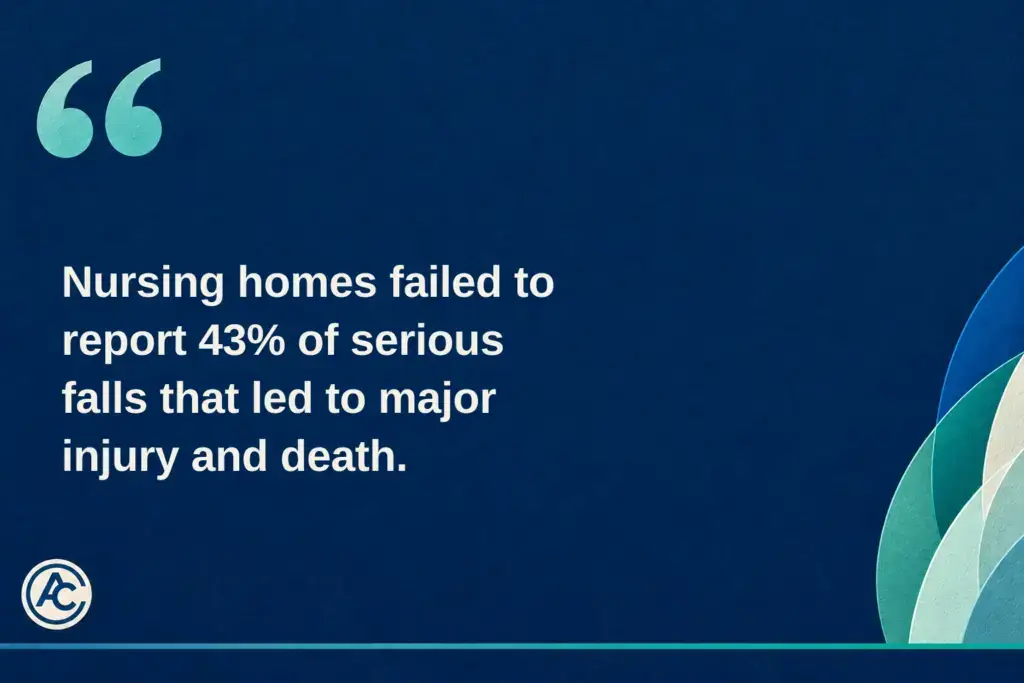
Second, the underreporting problem. A September 2025 HHS Office of Inspector General report compared Medicare hospital claims to nursing home Minimum Data Set assessments and found that 42,864 Medicare residents had a fall leading to major injury and hospitalization, with 1,911 dying while hospitalized. Nursing homes did not report 43% of those falls in MDS assessments, which they are required to do. OIG explicitly flagged that for-profit, chain-owned, and large nursing homes were the worst offenders, failing to report about 45% of serious falls.
Third, the older OIG hospital study (OEI-06-18-00400, May 2022) found that 25% of Medicare patients experienced patient harm during their hospital stays, and in the January 2025 Work Plan, OIG announced a review of the extent to which hospitals reported harm events as required per CMS program and State requirements.
Fourth, the money. HIPAA breach penalties alone are not small. The HHS 2024 annual adjustment set the per-violation tiers at $137 for no knowledge, up to $71,162 for willful neglect not corrected, with an annual cap of $2,134,831 per violation category. CMS civil monetary penalties for nursing homes under 42 CFR Part 488 can run up to $25,514 per day for ongoing noncompliance and up to $26,169 per instance. Translation for operators: when the intake lives in a shared inbox or a paper binder, the gap between occurrence and notification is where enforcement lives, and the arithmetic adds up fast.
From intake to state notification to CAPA to survey binder
Most incident tools stop at task routing. We built the opposite. When a clinical director in a Houston facility logs a medication error at 7:14 p.m., the AccrediCulture record does five things in parallel. It classifies the event against CMS QAPI standards at 42 CFR 483.75 and the Joint Commission Sentinel Event Policy. It opens the right state clock (TX HHSC, NY DOH, CA CDPH, FL AHCA, whichever applies). It routes a notification to the compliance officer and medical director. It starts a CAPA with a root cause analysis template keyed to the event type. And it attaches the record to the next mock survey binder as evidence.
No one retypes anything. The incident becomes the notification becomes the CAPA becomes the survey evidence on a single thread. That is what continuous readiness looks like when the operator is holding the pen.
Why it matters: the HIPAA Breach Notification Rule requires notice to affected individuals without unreasonable delay and in no case later than 60 days, and to HHS within 60 days for breaches of 500 or more individuals. Joint Commission expects a root cause analysis within 45 calendar days. NYPORTS Category 1 is 24 hours. OSHA requires fatality reports within 8 hours and hospitalization reports within 24 hours under 29 CFR 1904.39. These clocks do not share a calendar. The software has to.
What surveyors look for when they pull your incident log
When a Joint Commission surveyor sits down on day two and asks for the incident log, they are not reading for drama. They are checking three things. Was the event classified correctly. Was the notification sent on time. Was the corrective action closed with evidence. If any one of those breaks, the finding writes itself.
As the Joint Commission notes in its 2024 report, “no conclusions should be drawn about the actual relative frequency of events or trends in events over time,” because the data is voluntary and incomplete. Surveyors know that. They compensate by digging into whether your internal logs match what you submitted, and whether your CAPA closed the loop. A clean incident record with a timestamped notification and a documented CAPA is worth more than a tidy PDF policy.
A few operator habits that hold up well during an EOC tour or a chart audit:
- Classify at intake, not later. The event type and severity drive the clock. Classification done the next morning is already late.
- Keep the rules library current. State DOH definitions change. CMS updates Appendix A, PP, and Q. The library needs an owner.
- Close CAPAs with evidence, not narrative. Attach the retraining roster, the policy update, the audit result. Surveyors read attachments.
- Run a quarterly mock survey against the incident log. Pull ten events at random. Walk each one from intake to closure. The holes show up fast.
Frequently asked questions
Which events are state-reportable versus accreditor-reportable, and who decides? State statute decides state-reportable. Your accreditor decides accreditor-reportable. The two overlap often but are not identical. A NYPORTS Category 1 event in New York is defined by Public Health Law 2805-L and Title 10 NYCRR 405.8 and 751.10. A Joint Commission sentinel event is defined by the Sentinel Event Policy. The same fall can be both. Your incident software should flag both clocks independently.
How fast must an incident be reported to CMS, The Joint Commission, or a state DOH? CMS does not set a single universal clock, but Conditions of Participation at 42 CFR 482.13 and 482.42 require specific notifications (restraint deaths to CMS within specified windows, for example). Joint Commission expects a root cause analysis and action plan within 45 calendar days of awareness. NYPORTS Category 1 is 24 hours from discovery. HIPAA breach notification is within 60 days. OSHA 29 CFR 1904 requires fatality reports within 8 hours and in-patient hospitalization reports within 24 hours. The software’s job is to know which clock applies.
Can incident reporting software integrate with state portals like NYPORTS or CDPH eSRS? NYPORTS runs inside New York’s Health Commerce System and requires a designated user with an HCS account to submit, as the NY DOH describes. CDPH eSRS has its own submission workflow. Direct API integration with these state portals is rare. What realistic software does is prepare the submission packet, timestamp it, and track the submission confirmation, so the audit trail is complete even when the final keystroke happens in the state system.
What is the difference between a sentinel event, an adverse event, and a near miss in regulatory terms? A sentinel event, in Joint Commission language, is a patient safety event that results in severe temporary harm, permanent harm, or death. An adverse event is broader and is the term CMS and OIG use for harm caused by medical care. A near miss (or close call) is an event that could have reached the patient but did not. All three belong in the incident log. Only some trigger external reporting.
How does automated flagging reduce the risk of civil monetary penalties for late reporting? The penalty exposure is almost never about the event itself. It is about the gap between occurrence, discovery, and notification. With CMS per-day nursing home penalties running up to $25,514 and HIPAA willful neglect tiers reaching $71,162 per violation, a 48-hour delay on a single event can turn into a six-figure exposure. Automated flagging shortens that gap to minutes instead of days, produces a timestamp defensible on audit, and keeps the CAPA attached to the original record.
References
- Becker’s Hospital Review, 11 most common sentinel events in 2024: Joint Commission
- Skilled Nursing News, Hospital, Nursing Home Data and Communication Gaps Underpin OIG Falls Report (Sept 2025)
- HHS OIG, Adverse Events in Hospitals: A Quarter of Medicare Patients Experienced Harm in October 2018 (OEI-06-18-00400)
- HHS OIG January 2025 Work Plan Update: Patient Harm Events review
- HIPAA Journal, 2024 HIPAA Violation Penalty Tiers and Annual Caps
- Federal Register, CMS Civil Monetary Penalties Annual Inflation Adjustment (2024)
- New York State Department of Health, NYPORTS overview
- The Joint Commission, Sentinel Event Policy and Resources