
When a Psychiatric Facility Gets Shut Down: What CMS Actually Cites and How to Stay Ahead of It
October 23, 2026
On this page
Ready to be survey-ready?
The pattern CMS documents before a psychiatric facility closes
Mental health facilities get shut down when CMS or a state licensure agency builds a documented pattern of Immediate Jeopardy: unreported sentinel events, failed environment-of-care rounds, grievances that never escalated, and corrective action plans the facility never actually closed. Most of these surveys start with an ex-employee complaint, not a scheduled recertification, and the surveyors arrive unannounced with a specific allegation in hand.
CMS defines the trigger plainly. Immediate jeopardy is a situation in which a recipient of care has suffered or is likely to suffer serious injury, harm, impairment, or death as a result of a provider’s noncompliance with one or more health and safety requirements, and in the November 2024 revision to Appendix Q, CMS removed the “potential for serious harm” language that previously could trigger an IJ finding. The bar changed. Likelihood of harm, not theoretical risk, is what surveyors now document on the CMS-2567.
What matters for operators: by the time a surveyor is writing the 2567, the leading indicators were already visible inside the building for weeks or months. Missed EOC rounds. Open CAPAs past their due date. A grievance that was logged but never routed. A chart audit that flagged 1:1 observation gaps nobody closed. Those are the artifacts regulators cite.
What the Joint Commission's 2024 sentinel event data says about behavioral health risk
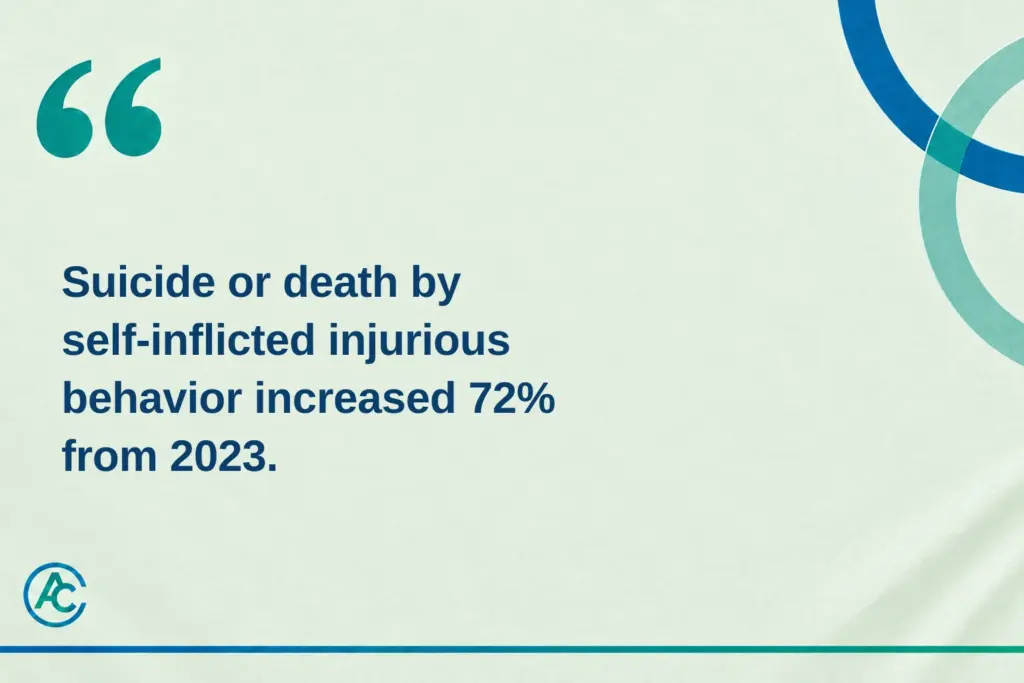
The numbers from accrediting bodies tell a specific story about where psychiatric settings fail. From January 1 to December 31, 2024, The Joint Commission received 1,575 reports of sentinel events, with patient falls accounting for 776 events (49%). In the behavioral health setting specifically, the leading sentinel events in psychiatric hospital settings were falls (38%), suicide or death by self-inflicted injurious behavior (20%), and workplace violence-related events. Reports are moving in the wrong direction too: reported suicide or death by self-inflicted injurious behavior increased 72% from 2023.
Ligature risk, 1:1 observation documentation, and elopement are the citation categories that psychiatric operators underestimate most. The Joint Commission’s R3 Report on ligature risk set the expectation years ago, and surveyors still find the same gaps: bathrooms and bedrooms missing the hardware upgrade, 15-minute checks initialed but not timestamped, environmental rounds signed off without evidence of a physical walkthrough.
As Joint Commission notes about the reporting itself, reporting sentinel events is a voluntary process and no conclusions should be drawn about the actual relative frequency of events. Translation for operators: the real event volume in the field is almost certainly higher than what shows up in the annual report. Internal incident capture has to be the ground truth, not the external filing.
Why ex-employee complaints land harder than any scheduled survey
Whistleblower activity in healthcare is at a historic high, and psychiatric facilities sit squarely inside the enforcement lane. In fiscal year 2024, whistleblowers filed 979 unique qui tam lawsuits, averaging 18 new cases filed every week and breaking the previous record set in 2013. The DOJ recouped more than $2.9 billion from False Claims Act settlements and judgments during fiscal year 2024, with nearly $1.7 billion of the total related to healthcare.
Not every ex-employee complaint becomes a qui tam case. Most become a hotline call to the state survey agency or an OCR intake. Either way, the mechanism is the same: a former clinician, tech, or nurse describes a specific event, names a specific date, and points to the chart. Surveyors arrive and ask to see that chart, the incident report, the grievance log, the staffing matrix for that shift, and the CAPA that was supposed to prevent recurrence. If any one of those documents is missing or inconsistent with the others, the citation writes itself.
Here is what operators can do about it. Make the internal grievance line the easiest path. Close the loop in writing with every complainant, employee or patient. Document the review, the finding, and the action taken. A facility that treats internal grievances seriously tends to see fewer external ones.
The command-center habits that keep you survey-ready instead of survey-scared
Pre-survey cramming does not work for psychiatric programs. The documentation trail is too deep and the surveyors know what cramming looks like. What works is a small set of habits, run every week, with one place to see them all.
- Chart audits on a rolling schedule. Not just coverage of medical necessity, but 1:1 observation entries, medication reconciliation at every level-of-care change, and discharge documentation that matches the authorized stay.
- Environment-of-care rounds that produce evidence. Photos, timestamps, named rounder, and a work order ID for any finding. Ligature risk sweeps on a defined cadence with the hardware list attached.
- Incident capture that runs 24/7. Night-shift staff need the same reporting path as day-shift leadership. A sentinel event discovered Monday morning that happened Friday night is already a documentation problem.
- Grievances tracked from intake to closure. Date received, acknowledgement sent, investigator assigned, finding, response to complainant, CAPA if indicated. No open items past the clock.
- CAPAs with real closure criteria. A corrective action is not closed because a policy was rewritten. It is closed when the audit shows the behavior changed.
- Credentialing and PSV current for every provider. No expired licenses, no gaps, no missing primary-source verifications.
This is where AccrediCulture earns its keep. One system where the compliance officer, the clinical director, and the COO can see the same leading indicators the surveyor will later ask about. Missed rounds surface before the week ends. Open CAPAs show their age. Grievances route automatically. Chart audits run on schedule. When an unannounced surveyor walks in, the binder is already assembled because the operators built it in the regular course of running the program.
Frequently asked questions
What triggers a CMS complaint survey at a behavioral health facility?
Most complaint surveys start with a specific allegation from a current or former employee, a patient, or a family member, routed through the state survey agency. The complaint names a date, a patient (sometimes), and an event. Surveyors arrive unannounced and investigate that specific allegation plus any conditions-level concerns they observe while on site.
What is Immediate Jeopardy and how fast must a facility respond?
Immediate Jeopardy is the most severe deficiency that can be imposed by CMS or state survey agencies and carries with it the potential for the highest level of fines and sanctions. Facilities must submit a removal plan on-site, typically within hours, and demonstrate that the immediate harm has been abated before surveyors leave. A full Plan of Correction follows on the standard 2567 timeline.
How should psychiatric facilities document and escalate grievances to avoid regulatory action?
Log every grievance at intake with date, source, and category. Acknowledge the complainant in writing within the required window. Assign an investigator, document findings, and respond to the complainant with the outcome. If a CAPA is indicated, link it and track closure. Keep the whole chain in one system so nothing lives in someone’s inbox.
What are the most common survey citations for inpatient psychiatric facilities?
Ligature risk in bathrooms and bedrooms, incomplete 1:1 observation documentation, missed environment-of-care rounds, medication reconciliation gaps at level-of-care transitions, incomplete incident investigations, and credentialing or primary-source verification lapses. Joint Commission 2024 data shows falls, suicide or self-injurious behavior, and workplace violence as the leading psychiatric sentinel event categories.
How long does a facility have to submit and close a Plan of Correction after a 2567?
The standard window to submit an acceptable Plan of Correction is 10 calendar days from receipt of the CMS-2567. Completion dates for each cited deficiency are proposed by the facility and must be reasonable to the citation. For Immediate Jeopardy, removal is required before the survey ends; the broader POC still follows the 10-day rule.
References
- CMS QSO-25-09-ALL: Revisions to Appendix Q, Guidance on Immediate Jeopardy (November 21, 2024)
- The Joint Commission Sentinel Event Data 2024 Annual Review
- Baker Donelson: CMS Revises Immediate Jeopardy Guidance, Key Updates for Providers
- Fierce Healthcare: DOJ Secured $1.7B from Healthcare False Claims Settlements in FY2024
- Feldesman: $2.9 Billion in False Claims Act Recoveries for FY 2024
- Becker’s Hospital Review: 11 Most Common Sentinel Events in 2024