
One Platform for Policies, Training, Incidents, and Audits: Why Consolidation Wins
November 13, 2026
On this page
Ready to be survey-ready?
The single thread of evidence a surveyor actually follows
Healthcare organizations should consolidate policies, training, incidents, and audits onto one platform when they want to survive a survey without rebuilding the evidence chain on the fly. Surveyors from The Joint Commission, CARF, AAAHC, and state DOH teams follow a single thread: policy version → staff acknowledgment → competency → incident → root cause → corrective action plan → re-audit. When those links live in four different vendors, the thread breaks at the handoff, and that is where findings get written.
Best-of-breed still has a place for very specific workflows. But for the artifacts a surveyor asks to see in the room, fragmentation is what produces the "show me how you know" moment that nobody wants on survey day.
We have watched a Tennessee hospital open a policy in PowerDMS, pull training records from Relias, export incidents from a separate ticketing tool, and try to stitch a CAP together in a SharePoint folder, all while a surveyor waited. The policy was current. The training was done. The incident was logged. The CAP existed. None of it connected on a single timeline, and the finding stood.
What the data says about fragmentation and risk
Three numbers should sit on every compliance officer’s desk.
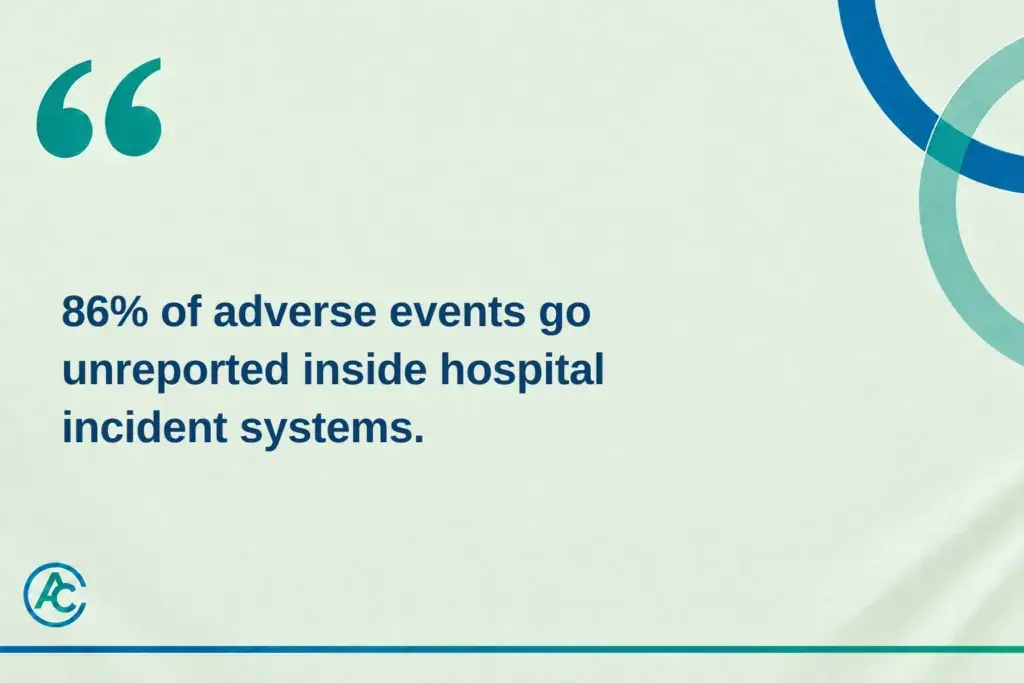
- 86% of adverse events go unreported inside hospital incident systems. The HHS Office of Inspector General found that hospital staff did not report 86 percent of events to incident reporting systems, largely because staff did not perceive the event as reportable. Fragmented tools make that worse, because the reporting path is not where the clinician already works.
- Average hospital RN turnover was 16.4% in 2024, climbing to 17.6% in 2025. Per the NSI National Health Care Retention & RN Staffing Report, first-year employee turnover sits near 29.5%. Every departure triggers an offboarding, a re-credentialing, a training reassignment, and a policy re-acknowledgment. Across four systems, that is four tickets.
- Infection Control, Environment of Care, Life Safety, and Medication Management remain the chapters that punish thin operations. TJC’s April 2024 Perspectives summary ranked IC.02.02.01 EP 2 (high-level disinfection), IC.02.01.01 EP 2 (standard precautions and PPE), and MM.01.01.03 EP 2 (high-alert medications) at the top of higher-SAFER-risk citations for 2023. All three sit at the intersection of policy, training, and audit.
As the OIG put it plainly: "incident reports were not filed for the vast majority of these adverse events." One system, used in the workflow where care actually happens, is how you start to close that gap.
Mapping each module to a cited standard, not to generic 'compliance'
A consolidated platform earns its place when every module connects to a specific regulator expectation.
- Policy management ties to CMS Conditions of Participation and TJC Leadership (LD) chapter requirements for current, approved, and disseminated policies.
- Training and competency tie to OSHA’s Bloodborne Pathogens Standard (29 CFR 1910.1030), TJC HR standards, and CMS QAPI expectations.
- Incident and grievance management tie to CMS CoP §482.13 (patient rights), PSQIA/PSO protections, and the OIG’s findings on underreporting.
- Environment of care and emergency management tie to TJC EC and EM chapters and the CMS Emergency Preparedness Rule (42 CFR 482.15).
- Credentialing and primary source verification tie to NCQA credentialing standards and payer delegation audits.
- Chart audits and corrective action plans tie to CMS QAPI (42 CFR 482.21) and the SAFER-matrix evidence of compliance that surveyors expect after any finding.
When a surveyor pulls IC.02.02.01 EP 2, our customers show the standard, the policy version staff acknowledged, the competency pass, the EOC tour log, the related incident (if any), the RCA, the CAP, and the re-audit result. One screen. One timeline. In California, Maryland, and Florida state surveys this year, that single-pane view is what shortened the CAP cycle from weeks to days.
The migration question: what to do about PowerDMS, Relias, and your incident tool
Operators do not switch platforms because they love switching platforms. They switch when the handoffs keep producing findings. If you are running separate systems today, here is the order that keeps you from losing history.
- Freeze the current policy library and export it with version history intact. The surveyor’s interest is the approved-at-the-time version, not the latest one.
- Map training records to the standard, not the course title. TJC and DNV surveyors ask what competency the training proves, not what the module was called.
- Bring incidents in as structured events, not PDFs. You want to query them later against grievance patterns and EOC rounding findings.
- Keep historical CAPs linked to the original finding. If a 2024 finding reopens in a 2026 survey, you need the evidence of correction, the re-audit, and the sustainment data.
- Protect integrations to HRIS, EHR, and credentialing PSV sources. Consolidation is not isolation. A good platform receives roster updates from Workday or UKG, reads active status from the EHR, and pulls PSV from NPDB, OIG LEIE, and state boards.
Done properly, migration takes a quarter, not a year. We have run it for multi-site operators in New York, Texas, and Arizona with zero gap in survey readiness.
Frequently asked questions
What is the real cost of running separate policy, LMS, incident, and audit systems?
License fees are the smallest piece. The real cost shows up as duplicate data entry, reconciliation hours during survey prep, and findings that stick because the evidence chain was not visible. The NSI 2026 report pegs first-year employee turnover near 29.5%, which means your compliance team re-does policy acknowledgments, training assignments, and credentialing records in four systems for the same person, every time.
How does platform consolidation actually reduce Joint Commission survey findings?
Findings get written when the surveyor cannot see the evidence of compliance in a reasonable amount of time. A consolidated platform shows the policy, the acknowledgment, the competency, the incident, the CAP, and the re-audit on one timeline, which is exactly what the SAFER matrix is evaluating.
Can one platform handle both acute care and ambulatory or behavioral accreditation standards?
Yes, when the platform is built around standards libraries rather than one accreditor’s template. We support TJC, CARF, AAAHC, COA, DNV NIAHO, and ACHC with chapter-specific crosswalks, so a system serving an ambulatory surgery center under AAAHC and a residential program under CARF uses the same evidence model.
What integrations should a consolidated platform still support?
HRIS (Workday, UKG, Paylocity) for roster and termination events, EHR for active clinician status, credentialing PSV sources (NPDB, OIG LEIE, SAM.gov, state boards), SSO, and your BI tool for reporting. Consolidation of the workflow does not mean rejection of the data layer.
How do we migrate from PowerDMS, Relias, and a separate incident tool without losing historical evidence?
Export policies with full version history, map training to the standard it proves, bring incidents in as structured records, and keep every CAP linked to its original finding. Plan on 90 days for a mid-size organization, with mock-survey testing at day 60.
If you want to talk through what the thread looks like in your organization, we are here. Calm, specific, and built for the operator sitting with the binder open.
References
- HHS OIG, Hospital Incident Reporting Systems Do Not Capture Most Patient Harm (OEI-06-09-00091)
- HHS OIG, Adverse Events in Hospitals: National Incidence Among Medicare Beneficiaries (OEI-06-09-00090)
- NSI Nursing Solutions, National Health Care Retention & RN Staffing Report
- AHRQ PSNet, Hospital Incident Reporting Systems Do Not Capture Most Patient Harm
- CMS Emergency Preparedness Rule (42 CFR 482.15)
- OSHA Bloodborne Pathogens Standard (29 CFR 1910.1030)
- The Joint Commission