
On this page
Ready to be survey-ready?
Readiness Is a State, Not an Event
Always survey-ready means your team operates every day the way it would operate the week a Joint Commission or CARF surveyor walks in. Not a scramble. Not a war room. Just the normal rhythm of the building. Most compliance officers I talk to already know this. The gap is between knowing and doing.
The data backs it up. In 2023, The Joint Commission analyzed a full year of survey results and the same categories kept surfacing: infection prevention and control activities during high-level disinfection and sterilization of medical equipment, and standard precautions including PPE use. These are not exotic standards. They are daily-work standards. Teams that treat them as daily work pass. Teams that treat them as a project sprint before survey week get cited.
Barrins & Associates, summarizing TJC’s own commentary, notes that roughly 60% of survey findings trace back to staff not following the organization’s own rules. Read that number again. It is not a standards problem. It is an operating-state problem.
Build Evidence as You Operate
When a nurse in a Tampa clinic finishes a medication reconciliation, the evidence should already be captured. Not reconstructed at 8pm on Thursday because the mock survey is Monday. Documentation as a byproduct of the work, not a separate project.
This matters more than it used to. A cross-sectional study published in The BMJ found that of 75 distinct components across 20 actionable Joint Commission standards, 68% were fully supported by at least one reference, while 17% had no supporting reference at all. Surveyors are not just checking that you did the thing. They are checking that the evidence lives where they can see it, on the day they ask. CARF operators describe the same pattern: the retrievability of documents during survey week, not their existence, is where first surveys lose points.
The CMS side is even more direct. Under 42 CFR Part 488, if state survey agencies find condition-level deficiencies that an accreditor missed, that gap is measured as a disparity rate. In the regulation’s own example, a 19% disparity rate is calculated when state agencies identify deficiencies at 60 facilities while the accreditor cited comparable findings at only 22. Translation for operators: the paper trail has to be complete for both sets of eyes, not one.
Make Accountability Visible
Every finding needs three things attached to it: an owner (a person, by name), a due date, and a verifiable closure. When those three fields are visible across the organization, gaps surface early. When they live in three different spreadsheets and a shared inbox, they surface during survey week in front of a surveyor.
This is the practical answer to what TJC’s SAFER Dashboard is asking you to do: sort findings by likelihood and scope, then act on them in that order. It is not a mystery process. It is a discipline. Kate Fenner of Compass Clinical Consulting, quoted in Briefings on The Joint Commission, made the operator’s point plainly: “EC and LS are covered by one dedicated person whose sole focus is to survey these standards, where physician and nurse surveyors have 1,800+ standards to hit.” Environment of Care and Life Safety keep topping the cited list because one specialist is hunting them full-time. Assign owners on your side who match that focus.
Ownership also drives what happens after the survey. Under CMS process, non-deemed hospitals always have to file plans of correction, and deemed hospitals generally do them when they have condition-level deficiencies. A CAP without a named owner is just a document. A CAP with an owner, a date, and a closure check is a corrective action.
What Continuous Readiness Actually Costs (and Saves)
Operators in Arizona and California ask me the same question: is continuous readiness worth the operational lift? Look at the alternative. A CARF one-year decision means the surveyors come back in twelve months instead of thirty-six. Every dollar of first-cycle prep, and industry estimates put a single-program treatment center’s first CARF cycle at roughly $15,000 to $45,000 all-in when factoring consultant gap analysis, policy rewrites, mock surveys, and staff time, gets spent again on the accelerated schedule. That is before you factor in what a follow-up survey costs when TJC returns within 45 days on a Medicare Deficiency Follow-up Survey after condition-level findings.
CARF’s own decision framework is clear about what a one-year outcome means: a Provisional Accreditation, awarded after a One-Year expires when the organization is still functioning at that level, requires functioning at the Three-Year level at the next survey or the outcome is Nonaccreditation. That is a one-year runway to fix an operating state, not a documentation project.
The Joint Commission’s structural pressure runs the same direction. Effective January 1, 2026, TJC is replacing the former National Patient Safety Goals chapter with fourteen high-priority topics organized to help hospitals track and improve outcomes. Fewer standards. Sharper focus. Operators who already run continuously will barely feel it. Operators who sprint will feel every inch.
What This Looks Like Inside AccrediCulture
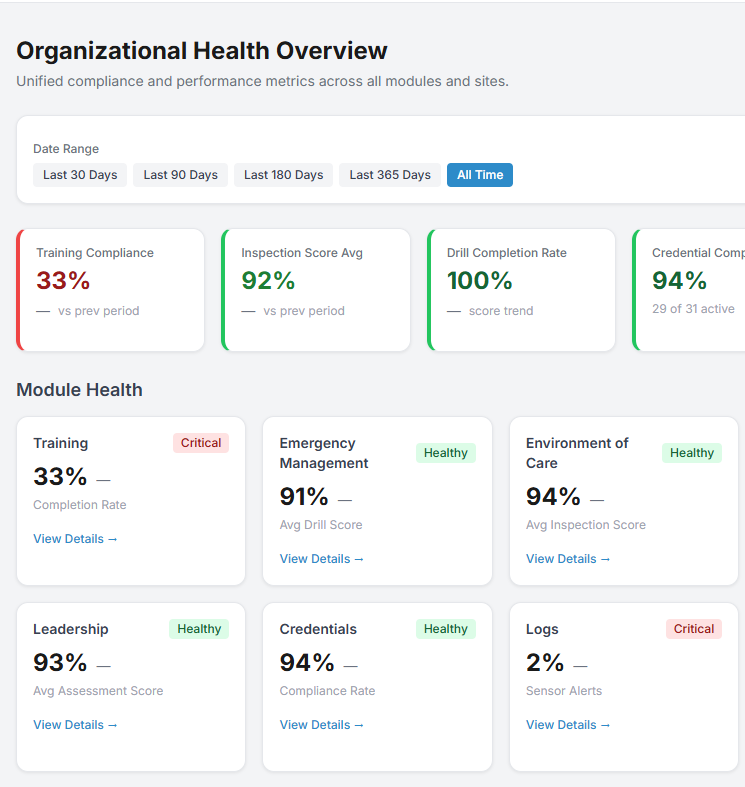
We built AccrediCulture because operators kept telling us the same thing: the standards are knowable, the work is doable, but the visibility is scattered. Policies in SharePoint. Credentialing in a spreadsheet. Incidents in an email chain. EOC tour notes on a clipboard. When a surveyor asks a Georgia clinical director for last quarter’s grievance log, the answer should be one click, not one afternoon.
So we put accreditation readiness, regulatory tracking, incident and grievance management, environment of care, emergency management, provider credentialing with primary source verification, chart audits, policy management, and corrective action plans into a single command center. One place where every finding has an owner, every policy has an effective date, every credential has a PSV timestamp, every CAPA has a closure check.
- Real-time visibility across TJC, CARF, AAAHC, and COA standards your programs are accredited under.
- Single source of truth for policies, drills, EOC tours, incidents, grievances, and audits.
- Named ownership on every finding, with due dates and verifiable closure.
- Continuous mock survey cadence instead of once-a-year panic.
Continuous readiness is not a slogan. It is what your operating state looks like on a random Tuesday. If that Tuesday would hold up under a surveyor’s questions, you are ready. If it would not, you already know what to fix.
Frequently asked questions
What does ‘always survey-ready’ actually mean in practice?
It means your organization operates every day the way it would operate during survey week. Evidence is captured as work happens, findings have named owners with due dates and verifiable closure, and documentation is retrievable on request. The Joint Commission has attributed roughly 60% of survey findings to staff not following the organization’s own rules, which is an operating-state problem, not a standards problem.
What are the most-cited Joint Commission standards operators should focus on first?
For 2023, TJC identified infection prevention standards, specifically IC.02.02.01 EP 2 (high-level disinfection and sterilization of medical equipment) and IC.02.01.01 EP 2 (standard precautions and PPE), as the top challenging requirements. Environment of Care and Life Safety standards also routinely top the most-cited list because TJC assigns dedicated engineer surveyors to them.
What happens if we get a one-year CARF decision instead of three years?
A One-Year Accreditation means CARF returns in twelve months, not thirty-six. If the organization is still functioning at the One-Year level at re-survey, CARF awards Provisional Accreditation, and the next survey must reach Three-Year level or the outcome becomes Nonaccreditation. Industry estimates put a single-program treatment center’s first CARF cycle at roughly $15,000 to $45,000 all-in, and a one-year decision effectively resets that clock.
Do we still need a plan of correction if we are Joint Commission accredited?
Under CMS process, non-deemed hospitals always have to file plans of correction on Form CMS-2567. Deemed hospitals (those surveyed by TJC or DNV on behalf of CMS) generally file plans of correction when they have condition-level deficiencies. Some deemed hospitals file voluntarily because the 2567 can be released publicly and they want their plan of correction released alongside it.
References
- The Joint Commission: Top 5 Most Challenging Requirements for 2023
- The Joint Commission: Standards and 2026 National Priorities Goals
- The Joint Commission: Most-Cited Hospital Standards and SAFER Dashboard
- CARF International: Accreditation Decisions
- eCFR: 42 CFR Part 488, Survey, Certification, and Enforcement Procedures
- BMJ / PMC: The Evidence Base for US Joint Commission Hospital Accreditation Standards
- Association of Health Care Journalists: Q&A with CMS on Hospital Inspection Reports
- Barrins & Associates: Frequently Scored Joint Commission Standards
- Accreditation & Quality Compliance Center: Top 10 Most-Cited Joint Commission Standards