
F550, F583, F584: What CMS Surveyors Are Citing on Resident Rights and Privacy
October 8, 2026
On this page
Ready to be survey-ready?
The F-tags surveyors are writing up right now
CMS state survey agencies are citing skilled nursing facilities under F550 (Resident Rights/Exercise of Rights), F557 (Respect and Dignity), F561 (Self-Determination), F583 (Personal Privacy and Confidentiality of Records), and F584 (Safe, Clean, Comfortable, Homelike Environment) when they see systemic breakdowns in resident autonomy and privacy. These sit inside 42 CFR Part 483 Subpart B and are interpreted through the State Operations Manual, Appendix PP. A citation here moves straight into the Five-Star Health Inspection domain on Nursing Home Care Compare, and depending on scope and severity it can trigger Civil Money Penalties under §488.408.
These are not fringe tags. According to CASPER data current as of April 27, 2025, the top ten most frequently cited F-tags nationally included F880 Infection Prevention & Control, F812 Food Sanitation, F761 Label/Store Drugs and Biologicals, F689 Free of Accident Hazards, F656 Comprehensive Care Plan, F684 Quality of Care, F695 Respiratory/Tracheostomy Care, F550 Resident Rights/Exercise of Rights, F677 ADL Care for Dependent Residents, and F584 Safe/Clean/Comfortable/Homelike Environment. Two of those ten are resident-rights tags. That is the signal.
What Appendix PP actually asks for under F550, F583, and F584
Appendix PP is specific, and surveyors read it closely. Under §483.10(a), the resident has a right to a dignified existence, self-determination, and communication with and access to persons and services inside and outside the facility. F550 is where surveyors land when a facility blocks that right, by policy or by practice.
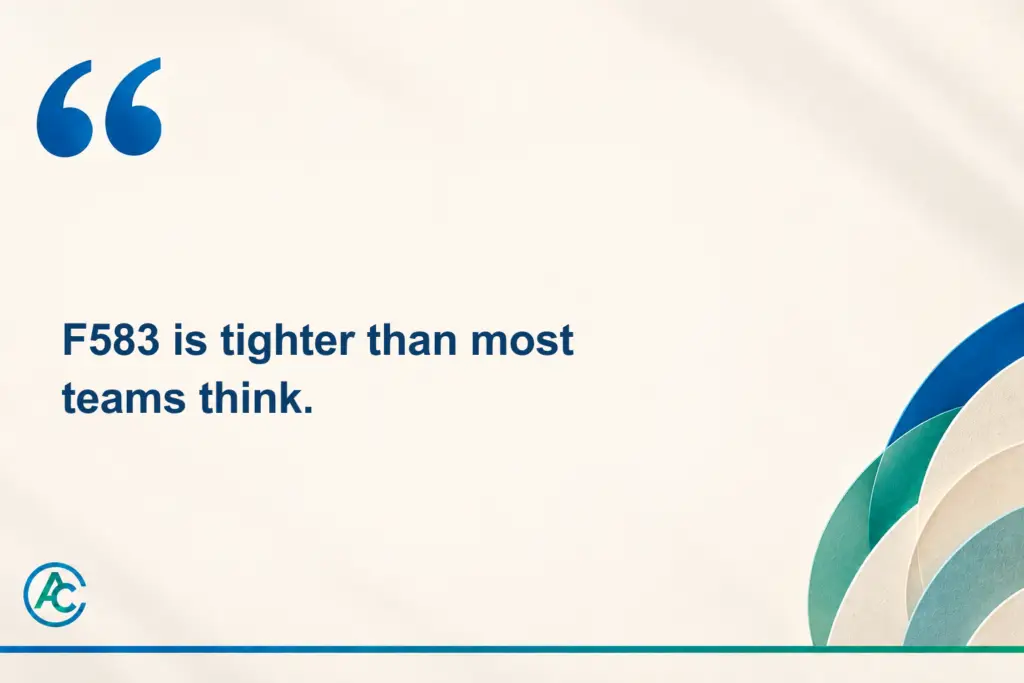
F583 is tighter than most teams think. Photographs or recordings of a resident or their private space without written consent are a violation of the resident’s right to privacy and confidentiality, including unauthorized staff photos. It also covers closing privacy curtains during ADL care, keeping charting out of public sightlines, and not discussing residents where visitors can hear. Residents should not be excluded from conversations during care, staff should not discuss residents where others can overhear protected information, catheter bags should not be left uncovered, and residents should not be restricted from common areas open to the general public without a clinical reason.
F584 reads as an environment tag but surveyors use it as a dignity tag. Torn linens, dim lighting over a resident’s bed, broken closet doors, personal items without a safe place to live. Those get written up, and they roll back into the resident-rights conversation.
How these citations hit Five-Star and the enforcement ladder
The Health Inspection domain on Nursing Home Care Compare is built from the three most recent standard surveys plus complaint and infection-control surveys. Deficiencies are weighted by scope and severity on the CMS grid. A single pattern-level F583 at scope E can push a facility down a star. A G-level or above can trigger immediate enforcement.
Historically the volume on resident rights has been steady. There were 679 citations of F550 in the period after the November 2017 survey process change, with 7 at a G or higher scope and severity; the number of G-level instances is relatively low, but the overall count is high given the significance of the deficiency. Complaint volume is also non-trivial on the ombudsman side. In federal fiscal year 2023, more than 1,500 full-time-equivalent staff and 3,443 trained volunteers in the Long-Term Care Ombudsman Program worked to resolve 202,894 complaints initiated by residents, families, and other concerned individuals. The ACL/NORS Residents’ Rights complaint codes break out separately for Access to information and records, Live in a less restrictive setting, Dignity and respect, Privacy, Response to complaints, Retaliation, Visitors, Resident or family council, and Other rights and preferences. Those codes map almost one to one onto F550, F561, F583, and F585 territory, which is why ombudsman trends are a leading indicator of what shows up on your 2567.
The evidence surveyors ask for, and how to have it ready
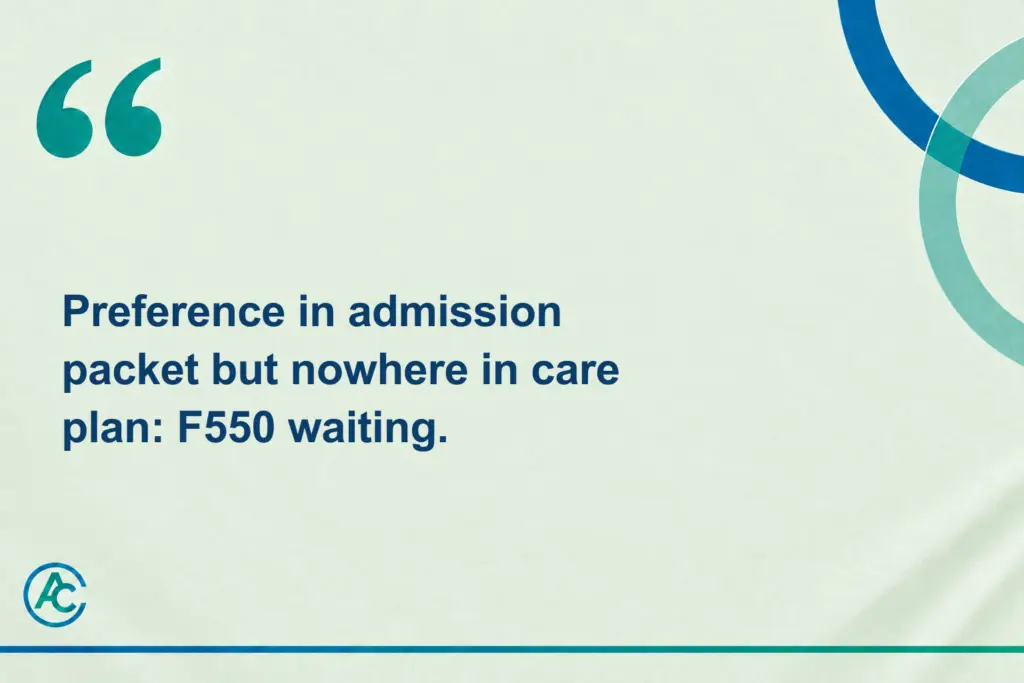
Appendix PP is not vague about proof. The Interpretive Guidance notes that all activities and interactions staff and volunteers have with residents must help residents maintain or enhance their self-esteem and self-worth and incorporate their goals, preferences, and choices. That means your documentation has to connect the resident’s stated preferences to the care plan, the daily task list, and the staff who executed on it. If a surveyor pulls a chart and the preference is in the admission packet but nowhere in the care plan, that is an F550 or F561 waiting to be written.
At AccrediCulture we help SNF compliance teams build a single source of truth that ties each resident-rights F-tag to the artifacts a surveyor will ask for: the current policy, the staff attestation that they read and were trained on it, the environmental rounds log showing privacy curtains intact and lighting adequate, the grievance log with resolution timelines, the informed-consent entries for photos and recordings, and the CAPA when something slipped. One record, pulled in one click, during survey week. The reader does not need a tour; they need the document.
- F550: Resident council minutes, grievance log, non-retaliation policy, admission rights acknowledgment, interpreter use records.
- F557: Dignity-in-care observations, dining-room rounds, staff coaching notes.
- F561: Care plan entries that cite the resident’s own words for preferences, refusal documentation.
- F583: Written photo/recording consents, HIPAA training attestations, curtain and door audits, chart-security rounds.
- F584: EOC rounds with photo evidence, work-order close-out logs, housekeeping schedules.
Frequently asked questions
Which F-tags cover resident privacy and independence?
The core cluster is F550 (Resident Rights/Exercise of Rights), F551 (Rights Exercised by Representative), F557 (Respect and Dignity), F561 (Self-Determination), F583 (Personal Privacy and Confidentiality of Records), and F584 (Safe, Clean, Comfortable, Homelike Environment). Appendix PP explicitly directs surveyors to F583 for visual-privacy deficiencies during treatment or ADL care in the bedroom, bathroom, or bathing room, and to F561 at §483.10(f)(1)-(3),(8) for self-determination gaps.
How do resident rights deficiencies affect a facility’s Five-Star rating?
The Health Inspection domain on Nursing Home Care Compare uses the most recent three standard surveys plus complaints, scored by scope and severity. Pattern or widespread findings on F550, F583, or F584 add weighted points that pull the Health Inspection star down, which in turn pulls Overall Five-Star down.
What documentation do surveyors expect for self-determination and informed consent?
Care plan entries that reflect the resident’s own stated preferences, refusal-of-care documentation, written consents for photos and recordings, and evidence that the interdisciplinary team revisited preferences at each care conference. For residents who use a representative, facilities must ensure the representative does not make decisions that exceed the rights set out by the resident, and must keep the resident involved in the decision-making process.
What are examples of F583 personal privacy violations surveyors commonly cite?
Open privacy curtains during ADL care, charting on screens visible from the hallway, staff conversations about residents in common areas, unauthorized photos, mail opened without consent, and phone calls monitored without reason.
How often should SNFs audit policies and staff training on resident rights?
At minimum annually, with a focused mock survey at the midpoint of your recertification window and targeted rounds monthly on the environmental and privacy items that drive F583 and F584. Tie each audit to a staff attestation and, when a gap appears, to a CAPA with a named owner and a close-out date.
References
- CMS State Operations Manual, Appendix PP – Guidance to Surveyors for Long-Term Care Facilities
- CMS Compliance Group – Top 10 Most Frequently Cited F-tags (CASPER data, April 2025)
- Administration for Community Living – Long-Term Care Ombudsman Program and NORS Data
- National Ombudsman Reporting System (NORS) Complaint Codes and Definitions
- F-Tags in Review: F550 Resident Rights – Citation Volume Analysis
- Ftag of the Week – F583 Personal Privacy and Confidentiality of Records
- CMS Nursing Home Care Compare (Five-Star Quality Rating System)