
Infection Control Risk Assessment for Long-Term Care: An F-Tag Indexed Walkthrough
October 4, 2026
On this page
Ready to be survey-ready?
What a long-term care ICRA actually is, under 42 CFR §483.80
An infection control risk assessment (ICRA) for long-term care is a documented, facility-specific analysis that identifies pathogen risks, resident vulnerabilities, environmental hazards, and surveillance gaps, then ranks them to drive the facility’s annual Infection Prevention and Control Program (IPCP). CMS surveyors expect it reviewed at least annually, after any outbreak, and whenever services, population, or construction change.
The regulation sits at 42 CFR §483.80. The facility must establish and maintain an infection prevention and control program designed to provide a safe, sanitary, and comfortable environment and to help prevent the development and transmission of communicable diseases and infections. The IPCP has to be built on the facility assessment and follow accepted national standards. Annual review: the facility will conduct an annual review of its IPCP and update their program, as necessary.
The ICRA is the analytical input. The IPCP is the operating program. Surveyors want to see both, and they want to see the line between them.
Why this matters right now: F880 citation data
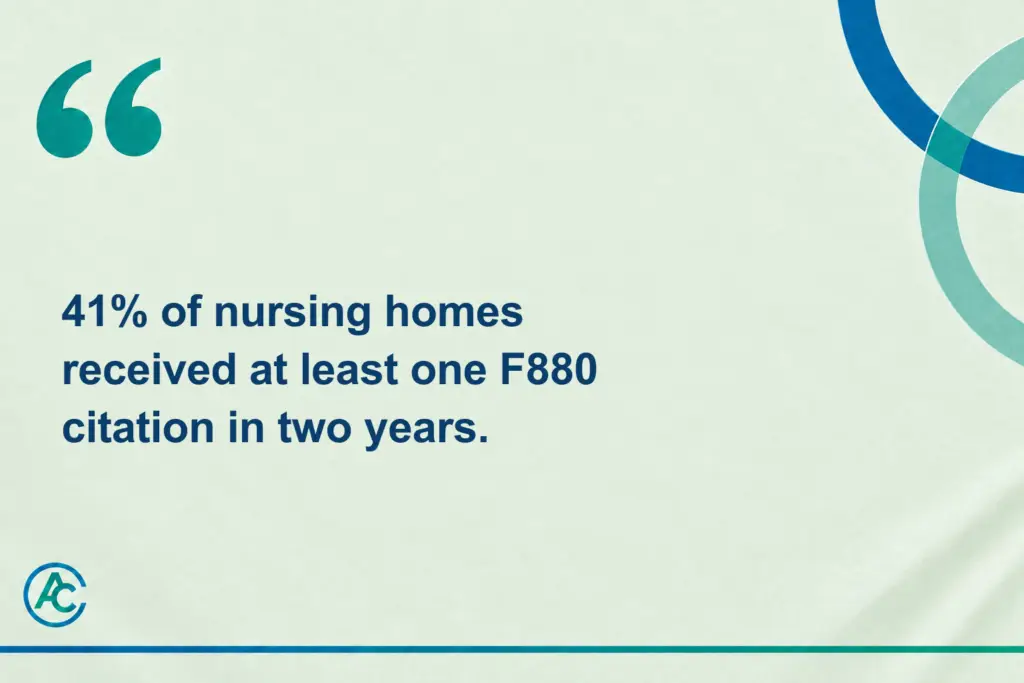
F880 is not a theoretical risk. It is the most-cited tag in the country. According to recent CMS deficiency data, infection prevention and control programs topped the list, with 24,924 citations affecting 81.6% of all nursing homes. One analysis of a recent two-year window found 41% of facilities received at least one F880 citation and 15% were cited multiple times over a two-year period.
Severity matters as much as frequency. While most F0880 citations (24,584) involved lower-level violations, 340 cases resulted in actual harm to residents or placed them in immediate jeopardy. During the pandemic surge, CMS reported it had cited more than 180 “immediate jeopardy” level deficiencies for infection prevention and control at nursing facilities, triple the rate from 2019, and that it had imposed civil money penalties exceeding $10 million for the deficiencies.
The population you are protecting is uniquely exposed. The CDC estimates that each day, approximately 1 in 38 U.S. Patients and 1 in 43 nursing home residents contracts at least one infection in association with their healthcare, underscoring the need for improvements in patient care practices in U.S. Healthcare facilities. A real ICRA is how you narrow that gap and show your work to a surveyor.
The six ICRA domains, mapped to the exact F-tag
Walk the risk assessment through six domains. Each one lines up with a specific F-tag under Appendix PP of the State Operations Manual. Keep this on one page in your binder. Surveyors read it in minutes.
- Pathogens (F880): List the organisms you actually see. UTIs, respiratory viruses, C. Difficile, MDROs, scabies, norovirus. Pull last 12 months of surveillance line listings. Rank by frequency and transmissibility.
- Population (F880, F838 facility assessment): Acuity mix, indwelling devices, dialysis trips, dementia units, ventilator residents, behavioral health admits. These change your risk profile and your isolation needs.
- Environment (F880, F921, F908): Shared bathing rooms, hopper rooms, HVAC, construction, water management, soiled utility flow. The CDC ICAR tool for long-term care is the structured checklist for this walk.
- Staffing and training (F882, F883, F726): Who is the Infection Preventionist? The IP must have primary professional training in nursing, medical technology, microbiology, epidemiology, or other related field, be qualified by education, training, experience or certification, work at least part-time at the facility, and have completed specialized training in infection prevention and control.
- Supplies and antibiotic stewardship (F881): PPE par levels, hand hygiene product placement, and the antibiotic use protocols required under the stewardship program.
- Surveillance and reporting (F880, F884, F885): NHSN LTCF enrollment, line listings, outbreak thresholds, transmission-based precautions, and the reporting pipeline to the QAPI committee and the state health department.
What survey-ready documentation actually looks like
A real-world F880 citation reads like this: DON or designee will audit PPE usage and availability in hopper rooms weekly for 4 weeks and monthly for 2 weeks or longer as determined by audit results. Maintenance manager or designee will audit cleaning of hopper room weekly for 4 weeks and monthly for 2 months or longer as determined by audit results. That is a plan of correction from a real March 2025 South Dakota survey. The surveyor saw a gap, the facility had to produce audits on a cycle, and the clock started on the day of the finding.
Nancy Foss at Pathway Health put it plainly: “CMS F880 – Infection Prevention & Control remains one of the most frequently cited deficiencies nationwide.” The pattern underneath those citations is almost always the same. Observation plus a documentation gap equals a tag.
Build the artifact set once, keep it current, and the ICRA becomes a weapon instead of a scramble:
- Signed and dated ICRA (annually, and after triggers).
- IPCP policy that references the ICRA directly.
- Surveillance line listings for at least the last 12 months.
- IP job description, training certificates, and QAA meeting minutes showing IP participation.
- Antibiotic stewardship report with trend data.
- CDC ICAR tool completed within the last 12 months, with gaps closed in a tracked CAPA.
- Outbreak after-action reviews, if any, with ICRA updates triggered by them.
This is the kind of consolidation that AccrediCulture was built for. One place for the risk assessment, the policy it drives, the audits that prove it, the CAPAs that close the loop, and the QAPI minutes that tie it together.
Frequently asked questions
How often is a long-term care infection control risk assessment required under CMS rules?
At minimum, annually. The facility will conduct an annual review of its IPCP and update their program, as necessary. Also redo it after any outbreak, significant change in resident population or services, construction or renovation, and when CDC or CMS issues new guidance (for example, a QSO memo).
Who should participate in the ICRA, just the Infection Preventionist or the full QAPI committee?
The IP owns the document, but the QAA/QAPI committee signs off. The regulation requires that the individual designated as the IP, or at least one of the individuals if there is more than one IP, must be a member of the facility’s quality assessment and assurance committee and report to the committee on the IPCP on a regular basis. Bring in nursing leadership, environmental services, maintenance, dietary, and the medical director. Surveyors ask who contributed.
What is the difference between an ICRA and the annual IPCP review required under F880?
The ICRA is the risk analysis: what could hurt our residents, how likely, how severe. The IPCP review is the program evaluation: are our policies, surveillance, and interventions working against those risks. The ICRA feeds the IPCP review. Keep them as two linked documents, not one blended file.
What F-tags do surveyors most often cite when the risk assessment is weak or missing?
F880 first, almost always. Then F881 (antibiotic stewardship), F882 (IP designation and qualifications), and F885 (COVID-19 reporting and immunization). The most commonly cited tags are F880, F881, and F885, the core program requirements, antibiotic stewardship, and isolation precautions.
How should we document ICRA findings so they hold up during a CMS or state survey?
Date and sign it. Reference the data sources (NHSN line listings, ICAR tool, incident reports, environmental rounds). Rank risks by likelihood and severity. For each top-tier risk, link to the policy, the audit tool, and the CAPA that addresses it. Put the QAA meeting minutes in the same folder. If a surveyor asks for your ICRA and you can hand them one PDF that connects to everything else, you are already ahead.
References
- 42 CFR §483.80 Infection Control, Code of Federal Regulations (GovInfo)
- CDC Current HAI Progress Report
- CDC Infection Control Assessment and Response (ICAR) Tool for Long-term Care Facilities
- CDC HAI and Antimicrobial Use Prevalence Surveys
- Center for Medicare Advocacy: Infection Control Surveys in Nursing Facilities
- Senior Care Report Card: Top 10 Nursing Home Deficiencies, June 2026 CMS Data
- Pathway Health: Why F880 Remains the Top Citation
- Nursing Home Rates of HAIs Requiring Hospitalization, FY2022 (PMC)