
What Does Deemed Status Mean? A Plain-English Operator Guide to CMS Accreditation
October 19, 2026
On this page
Ready to be survey-ready?
The one-sentence definition, then the statute behind it
Deemed status means a healthcare organization has been accredited by a CMS-approved accrediting organization (AO) whose standards meet or exceed the Medicare Conditions of Participation (CoPs) or Conditions for Coverage (CfCs), so the Centers for Medicare & Medicaid Services treats that AO survey as a substitute for a direct state agency survey for Medicare certification. The authority sits in Section 1865 of the Social Security Act, which provides that if a provider is accredited by a national accreditation body under standards that meet or exceed the Medicare conditions of participation the Secretary can “deem” the provider as having met the Medicare requirements for those conditions.
CMS says it the same way on its own AO page: Section 1865(a) of the Act allows most health care facilities to demonstrate their compliance with the Medicare conditions through accreditation by a CMS-approved AO program, instead of being surveyed by SAs for certification. This is referred to as deemed status. The hospital CoPs themselves live at 42 CFR Part 482, and the CMS State Operations Manual, Appendix A is the interpretive guide surveyors actually work from.
One point we flag constantly for new compliance officers: accreditation is voluntary. Accreditation is voluntary and not required for participation in the Medicare program. You can be state-surveyed instead. Most hospitals pick deemed status because the AO relationship is more predictable than waiting on a state agency with a backlog.
Which AOs currently hold CMS deeming authority (and for what)
CMS has approved a short list of national AOs to deem specific provider and supplier types. The main hospital deeming programs are The Joint Commission (TJC), DNV Healthcare USA (NIAHO), the Accreditation Commission for Health Care (ACHC, which absorbed HFAP), and the Center for Improvement in Healthcare Quality (CIHQ). Ambulatory surgery centers have a different short list. As of August 2026, five organizations hold CMS deeming authority for ambulatory surgery centers: AAAHC, The Joint Commission, ACHC, QUAD A and DNV. DNV is the newcomer, granted initial ASC approval in December 2025, the first addition to this field in years.
CMS-approved AO programs also cover home health agencies, hospices, critical access hospitals, ESRD facilities, rural health clinics, outpatient physical therapy, and clinical laboratories under CLIA. The Community Health Accreditation Partner (CHAP) is the long-standing home health and hospice deeming program. One warning worth repeating: A CMS PDF listing ASC accrediting organizations still names HFAP and IMQ; neither holds current ASC deeming authority. A separate CMS complaint-contact list dated July 2022 is correct for the four incumbents but predates DNV. If you are checking a list, check its date.
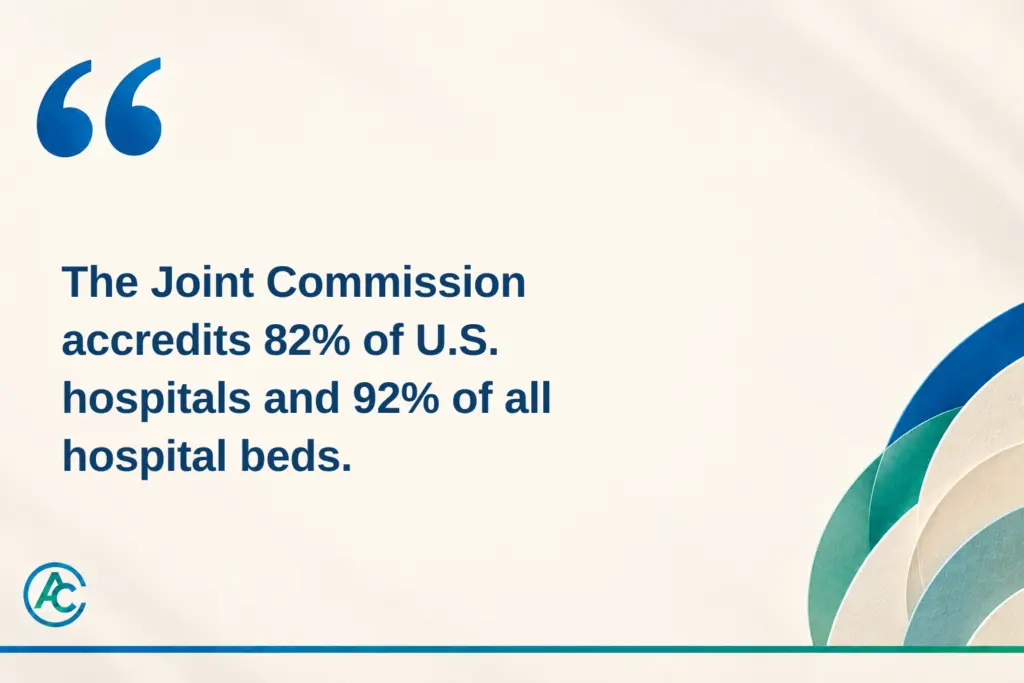
Market share tells you why TJC gets most of the attention. The Joint Commission accredits more than 4,500 hospitals representing 82% of U.S. Hospitals and 92% of hospital beds, with all surveys conducted unannounced within an 18-to-39-month window. The last comprehensive CMS report pegged hospital deeming at a similar level: according to CMS’s most recent report to Congress, in Fiscal Year (FY) 2015, 89 percent of hospitals, 3,500 hospitals in total, chose to demonstrate compliance with CoPs through accreditation.
The enforcement machinery: validation surveys, disparity rates, 60-day complaint authority
Deemed status is not a pass. CMS checks AO work two ways. First, to validate the AO hospital surveys, CMS uses its SAs to perform validation inspections on some hospitals that were previously surveyed by an AO. The validation process produces a disparity rate which determines the percentage of AO surveys that missed a problem found during the corresponding CMS inspection. Second, CMS retains direct authority to send a state agency in on a complaint within 60 days of an AO survey, regardless of your accreditation status.
The disparity numbers are not small. According to the most recent report, the FY 2020 Report to Congress, average disparity rates for all CMS-approved AO programs for the following facility types for the most recent year in the report (FY 2019) are: Hospitals (42 percent); Psychiatric hospitals (45 percent); Critical Access Hospitals (46 percent); Home Health Agencies (HHAs, 8 percent); Hospices (19 percent) and Ambulatory surgical centers in the mid-30s. In plain English: in roughly 4 out of 10 hospital validation surveys, the state agency found a Condition-level deficiency the AO had missed.
CMS has not been quiet about this. Then-Administrator Seema Verma said in 2018, “Our data shows that state-level audits of healthcare facilities are uncovering serious issues that AOs have missed, leading to high ‘disparity rates’ between the two reviews.” The agency has since proposed tighter rules through a 2026 Federal Register notice on strengthening AO oversight and preventing AO conflicts of interest, including publicly reportable plans of correction for significant negative AO performance measure findings. The era of a quiet, forgiving AO relationship is over.
What losing deemed status actually costs, and the Massachusetts case that lit the fuse
Losing accreditation is a Medicare billing problem, not a reputational one. A hospital that loses Joint Commission accreditation also loses the “deemed status” that lets it bill Medicare and Medicaid without undergoing separate CMS surveys. For a mid-size acute-care hospital, that translates to hundreds of millions of dollars in annual reimbursement at risk. On the Joint Commission side, accreditation connects directly to CMS deemed status, making its loss a trigger for Medicare and Medicaid funding suspension after 90 days without remediation.
The Northampton, Massachusetts case made the stakes real for a lot of boards. A Wall Street Journal investigation referenced in congressional hearings highlighted the case of Cooley Dickinson Hospital in Northampton, Massachusetts, where CMS reported that the hospital’s failure to provide quality medical care, as required in the CoPs, resulted in the death of all three patients. Despite CMS’s finding, the hospital maintained full accreditation by TJC. That gap, between what the state agency saw and what the AO cited, is exactly what the current rulemaking targets.
For deemed-status hospitals in Texas, California, or Florida, the operational implication is the same: a Condition-level finding on an unannounced survey can convert to Immediate Jeopardy, trigger a 23-day termination track, or (less dramatically) land you in Conditional Accreditation. Conditional Accreditation is a public accreditation status issued when a hospital demonstrates patterns of non-compliance. It requires a follow-up survey within six months, triggers an automatic CMS notification, and is published on the Joint Commission Quality Check website. Lenders see that. So do payers.
What we tell every COO we work with: your deemed status is a daily condition, not a certificate. The AO window is open for years at a time. 42 CFR 488.5(a)(4)(i) requires every CMS-approved AO to re-survey by unannounced survey no later than 36 months after the prior accreditation effective date, this is the shared federal floor, not a TJC-specific choice. Build your policy library, your EOC tour evidence, your credentialing files, your incident and grievance logs, and your CAPA tracker so a surveyor can see the proof without a scramble. That is what AccrediCulture is for: a single source of truth your team actually uses between surveys, so survey week is a confirmation instead of a crisis.
Frequently asked questions
Which accrediting organizations currently have CMS deeming authority?
For hospitals, the active deeming programs are The Joint Commission, DNV Healthcare USA (NIAHO), ACHC (which absorbed HFAP), and CIHQ. For ASCs, as of August 2026, five organizations hold CMS deeming authority for ambulatory surgery centers: AAAHC, The Joint Commission, ACHC, QUAD A and DNV. CHAP and ACHC lead in home health and hospice. Check the current CMS AO list before you commit, because the roster changes.
Can CMS still survey my hospital if we have deemed status?
Yes. CMS retains validation survey authority and the right to send a state agency on a complaint within 60 days of an AO survey. CMS grants Joint Commission ‘deeming authority’ and deem each accredited hospital as meeting the federal Conditions of Participation; 5-10% of hospitals nationwide are selected randomly for CMS validation surveys. Deemed status removes the routine state survey, not the oversight.
What happens if we lose deemed status mid-accreditation cycle?
Your Medicare billing is at risk. Lose accreditation and accreditation connects directly to CMS deemed status, making its loss a trigger for Medicare and Medicaid funding suspension after 90 days without remediation. You can transition to state agency certification, but that path is slower and less predictable, and most CFOs do not want to find out what the gap looks like on a 13-week cash forecast.
Does deemed status apply to Medicaid as well as Medicare?
Primarily Medicare. State Medicaid agencies often recognize the same AO accreditation for their own certification requirements, but that varies by state and by provider type. In Maryland and New York, for example, state licensure sits on top of federal certification and has its own survey process. Always check your state’s licensure regulations alongside your CMS status.
How often does a deemed-status organization get surveyed, and are surveys unannounced?
Depends on the AO. The Joint Commission’s unannounced survey arrives roughly once every three years, which means a longer gap but a higher-stakes single event. DNV-accredited hospitals face fully unannounced surveys annually rather than on a triennial cycle, making year-round readiness a requirement rather than an aspiration. Either way, you are inside an open window the whole time.
References
- CMS, Accrediting Organizations (AOs) overview and current deeming programs
- CMS QSEP, Deemed Accreditation under Section 1865 of the Social Security Act
- Federal Register, Medicare Program: Strengthening Oversight of Accrediting Organizations and Preventing AO Conflicts of Interest (2026)
- CMS, Accrediting Organization Proposed Rule Fact Sheet
- CMS Press Release, CMS Seeks Public Comment on Accrediting Organizations’ Conflicts of Interest
- Strategic Management Services, Congress Questions CMS Oversight of Hospital Accrediting Organizations
- ASC Central, Choosing an ASC Accreditation Organization (2026 CMS deeming authority)